
Continue with
Registration Number
Continue without
Registration Number
I Have
Brand new Car
E20 petrol is becoming increasingly common across India, but what does it mean for your car? Understand how E20 differs from regular petrol, its impact on mileage and performance, and how to check your vehicle's compatibility before making the switch.
In the past few years, as India has rapidly moved toward cleaner and more sustainable transportation, E20 has become a familiar term for vehicle owners across the country. But what exactly is E20 petrol, and what does it mean for your car or bike?
E20 petrol is a blend containing up to 20% ethanol and 80% petrol. India is gradually adopting this fuel as part of its efforts to reduce carbon emissions, cut reliance on imported fossil fuels, and increase the use of renewable energy.
With E20 petrol becoming more widely available, vehicle owners need to understand how it works and whether their vehicle is compatible with it. In this Quickinsure blog, we will explain what E20 petrol is, how it affects vehicle performance and mileage, its key benefits and limitations, and what you should know before using it.
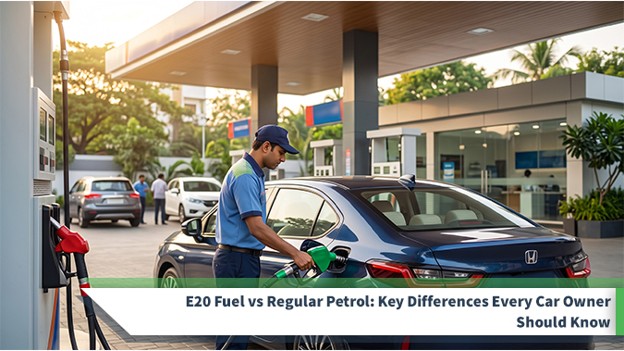
E20 refers to petrol containing up to 20% ethanol and 80% petrol by volume. Ethanol is an alcohol-based fuel produced from renewable sources and is blended with petrol as part of India’s broader ethanol-blending programme.
The government has promoted higher ethanol blending to reduce dependence on imported crude oil, support domestic ethanol production and lower certain vehicle emissions. India moved toward the E20 target as part of this transition, and IndianOil reported that E20 petrol was rolled out nationally in December 2024.
What people often call “regular petrol” is not necessarily pure petrol or E0. Petrol sold in India can already contain ethanol at different blending levels. So, E20 petrol vs normal petrol is better understood as a comparison between fuel with a higher ethanol blend and petrol with a lower ethanol blend.
The biggest question for many car owners is simple, “Will E20 reduce my car’s mileage?”
It can. Ethanol contains less energy per unit volume than petrol, so fuel efficiency may decrease in some vehicles. NITI Aayog’s E20 assessment estimated a fuel-efficiency reduction of around 6-7% for four-wheelers designed for E0 and calibrated for E10, while four-wheelers designed for E10 calibrated for E20 showed an estimated 1-2% reduction. Engine hardware and tuning can reduce the efficiency gap.
However, these figures should not be treated as a guaranteed mileage drop for every car. Your vehicle’s engine design, calibration, driving conditions, and maintenance can all influence actual results.
For most drivers, the difference may be more noticeable in fuel consumption than in everyday acceleration. Government testing cited by NITI Aayog found that E20 test vehicles passed hot and cold startability and drivability tests without severe malfunction or stalling.
This is where car owners need to pay attention. E20 is not automatically suitable for every petrol vehicle. Compatibility depends on the vehicle's design, fuel-system components, engine calibration and manufacturer's specifications.
Modern vehicles designed for E20 are engineered and tested with the higher ethanol blend in mind. Older petrol cars can have different compatibility requirements. Some manufacturers have specifically highlighted E20 compatibility for certain newer models, but this does not mean every petrol car from the same brand has identical specifications.
Before filling up with E20:
● Check your owner’s manual.
● Look for the recommended ethanol blend.
● Check the manufacturer’s official website or dealer information.
● Pay attention to the vehicle’s manufacturing year and specifications
● Follow the manufacturer's recommended maintenance schedule.
Don't rely solely on what another car owner experiences. The manufacturer's recommendation for your specific vehicle should be your first reference.
E20 is part of India's effort to increase the use of domestically produced renewable fuel. Higher ethanol blending can help reduce reliance on imported crude oil and has the potential to lower certain vehicle emissions.
NITI Aayog's assessment found reductions in carbon monoxide and hydrocarbon emissions with E20 compared with gasoline in its test programme, although results can vary with vehicle and engine characteristics.
For consumers, the long-term picture is therefore broader than mileage alone. E20 represents a shift in India's fuel ecosystem, while vehicle manufacturers continue adapting engines and fuel systems for higher ethanol blends.
There is no need to panic when you see an E20 at a petrol station. Instead, make an informed decision.
If your car is E20-compatible: Use the fuel recommended by the manufacturer and continue following the prescribed maintenance schedule.
If you own an older petrol car: Check the owner's manual or contact the manufacturer before assuming that E20 is suitable.
If you're buying a new car: Ask the dealer about E20 compatibility and check the manufacturer's specifications before making your decision.
Protect Your Car Beyond the Fuel Tank
Understanding your car's fuel requirements can help you make smarter ownership decisions. The right insurance can provide another layer of financial protection when unexpected incidents occur.
Compare car insurance plans with QuickInsure and choose coverage that fits your vehicle, driving needs and budget.
E20 can generally mix with lower-ethanol petrol, but it's best to follow your car manufacturer's recommended fuel rather than mixing fuels intentionally.
Check your owner's manual, vehicle documents, or the manufacturer's official website for compatibility information specific to your car model and year.
E20 compatibility alone does not determine resale value. The car's age, condition, maintenance history, mileage, and market demand usually matter more.
No. E20 is ethanol-blended petrol designed for compatible petrol engines. Diesel cars should use the fuel recommended by their manufacturer.
Yes, using unsuitable fuel can cause engine or fuel-system problems. If you refuel incorrectly, avoid driving and contact a qualified professional for advice.